Every family holds a treasure trove of memories, traditions, and wisdom that deserve to be shared—and now, there’s a heartfelt way to capture it all. The Genealogy Memory Book is a beautifully designed keepsake journal that invites parents, grandparents, and extended family members to preserve their life stories for future generations. With thoughtful prompts and ample space for answers, it transforms ordinary conversations into extraordinary heirlooms.
This book is more than just a collection of questions; it’s an invitation to connect across generations. From childhood memories and teenage adventures to parenting moments and cherished holiday traditions, each page helps uncover the rich layers of who we are and where we come from. Whether you’re learning about a grandparent’s first job or uncovering your family’s roots in DeKalb County, Tennessee, every answer adds a new branch to your family tree.
Designed with both kids and adults in mind, the Genealogy Memory Book fosters meaningful conversations that strengthen family bonds. It’s a perfect activity for a rainy afternoon, a family reunion, or a quiet one-on-one moment with a loved one. Add photos, drawings, recipes, or keepsakes along the way, and watch your family history come to life—one memory at a time.
Whether you’re just beginning your genealogy journey or you’re already deep into family research, this book is a powerful tool for preserving your legacy. It’s not just about where we came from—it’s about ensuring that those stories, values, and voices are never forgotten. Start your family’s storytelling tradition today and give your future generations the priceless gift of knowing who they are and where they come from.
We are in the process of obtaining quotes for hard copies, but until then, feel free to download the attached PDF and print it, or fill it out electronically.
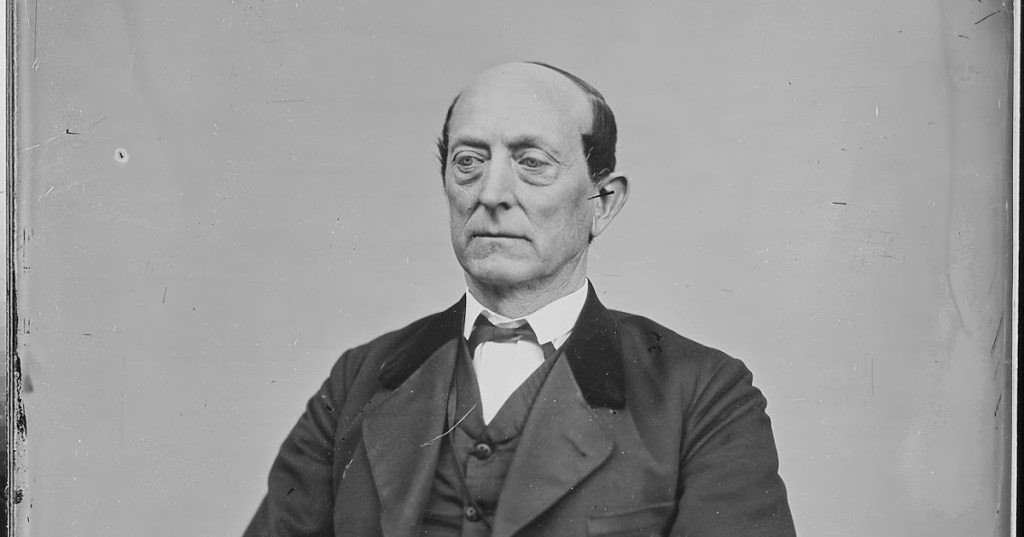
As many know, the Civil War left a significant imprint on Alexandria’s history, with several prominent citizens taking active roles on opposing sides. Colonel John Fite Goodner and his father, Major James Goodner, represented the Confederacy. Colonel William B. Stokes represented the Union. Remarkably, all three men are buried in Eastview Cemetery—just a short distance from one another.
Col William B. Stokes
Initially, sentiment in and around Alexandria appeared to favour the Confederacy. In April 1861, John F. Goodner quickly raised an infantry company in town, likely fearing the war would end before they could engage. This company became part of Robert Hatton’s 7th Tennessee Regiment. When Hatton was promoted to general, Goodner assumed command as colonel. The regiment fought primarily in Virginia and suffered devastating losses—according to researcher Mike Corley, only four or five men out of the original hundred survived the war.
Col John Fite Goodner
At the same time, Alexandria was also home to U.S. Congressman William B. Stokes of the 4th District. Though initially enslaving ten people and wavering in his position, Stokes ultimately declared his allegiance to the Union. Following the Union’s capture of Nashville in July 1862, he organized the 5th Tennessee Cavalry Regiment, becoming its colonel. Many men from DeKalb County joined the regiment, and by the war’s end, nearly as many DeKalb County residents had served in Union forces as in Confederate ones—some even on both sides.
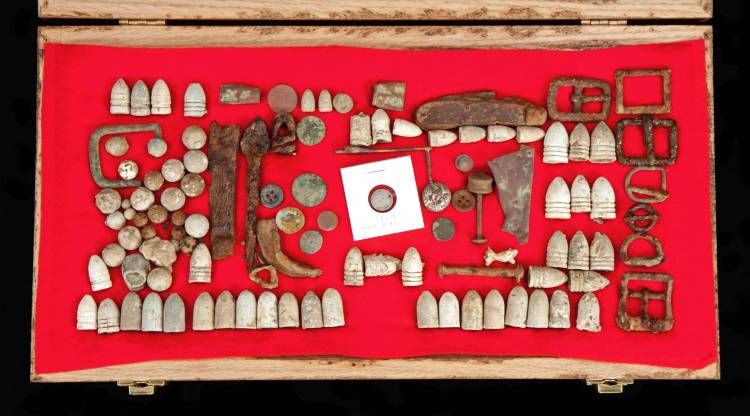
Items found near Alexandria skirmish location
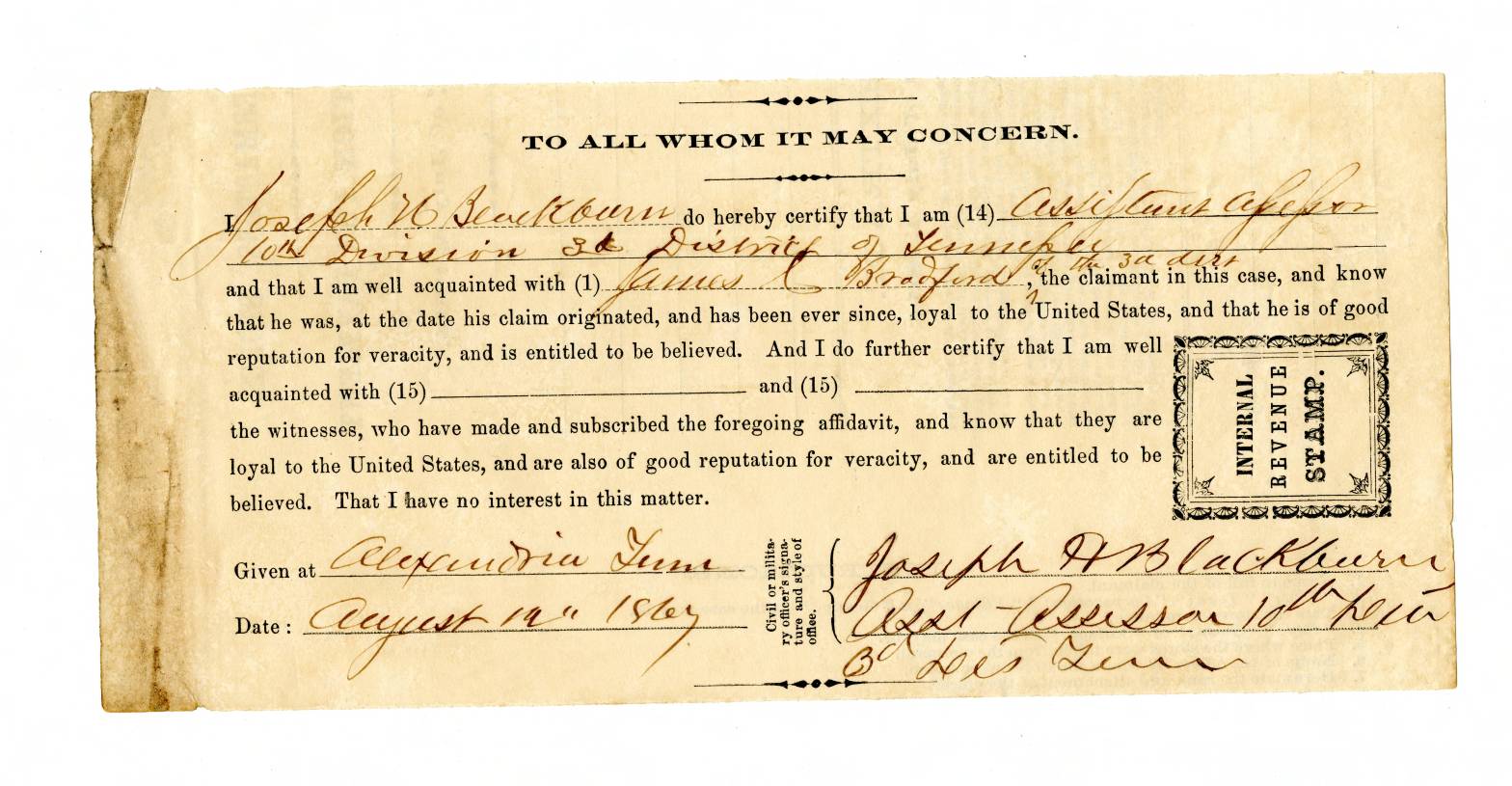
Alexandria experienced several skirmishes and minor engagements during the war, damaging the surrounding area. One of the most notable events was the gathering of General John Hunt Morgan’s men at the Alexandria fairgrounds on June 11, 1863, before embarking on their famed raid deep into Indiana and Ohio—the northernmost advance by any Confederate forces. Artifacts from the Civil War have since been uncovered in digs around Alexandria. In some cases, individuals were required to obtain witness statements that they had been loyal to the United States.
After the war concluded in 1865, Col. Goodner and Col. Stokes returned to Alexandria. Stokes resumed his political career as a Radical Republican in Congress. Though local historian Tommy Webb believed Stokes introduced the 15th Amendment, which granted formerly enslaved men the right to vote, further research shows he was a strong advocate but not the original sponsor.
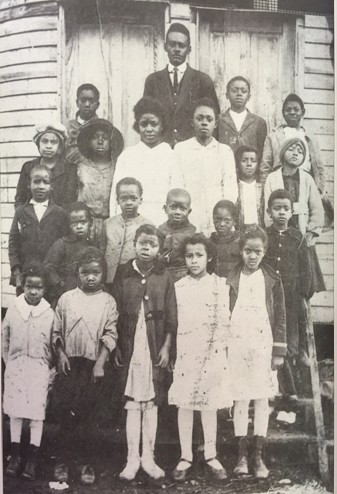
Following emancipation, many formerly enslaved people settled in the Cedar Hill area of Alexandria. There, they quickly established a school and a Methodist church, became property owners, and found work in various trades. According to Tommy Webb, some of the finest cooks in the world lived—and still live—in Cedar Hill. Around 1900, a cook’s wage was $1.75 per week, which included preparing breakfast and dinner, saving food for supper, washing dishes, and cleaning the kitchen.
Believed to be an early picture of Seay Chape
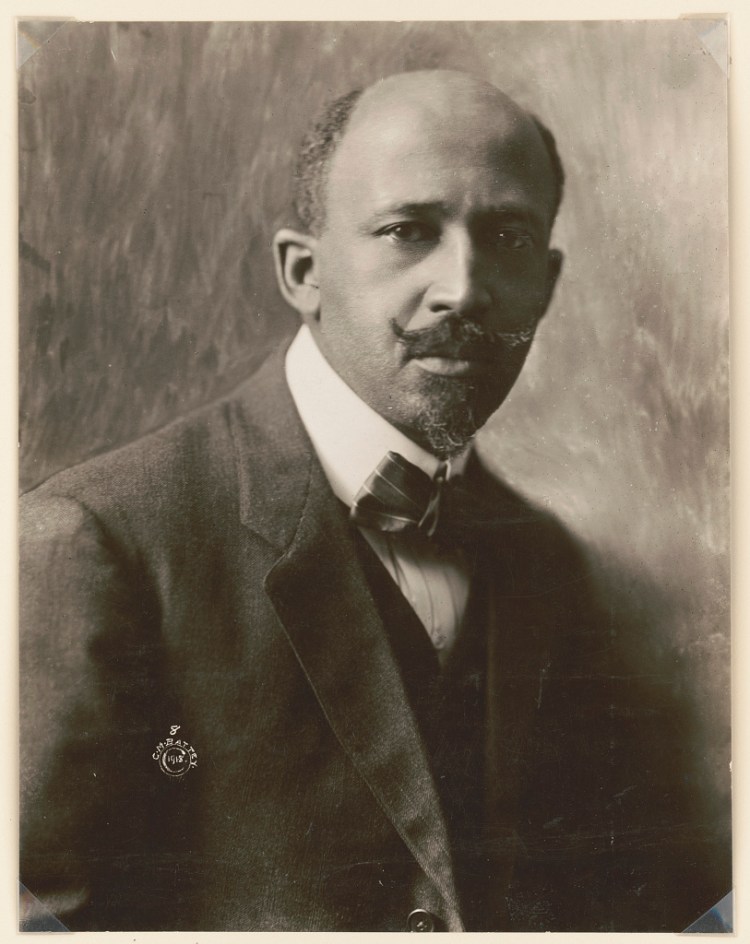
Alexandria also holds a brief but essential connection to W.E.B. Du Bois, co-founder of the NAACP. Around 1886, Du Bois taught at a Black school near Alexandria. In The Souls of Black Folk, he recalls attending services at several of the town’s Black churches, one of the pastors possibly being Rev. B.F. Whitley. Though Du Bois only stayed a few months, his income in Alexandria helped fund his education at Fisk University in Nashville. His writings, rich with insight and honesty, resonate deeply and shed light on the world he observed with such clarity and grace.
Cuddled on the hill to the north was the village of the colored folks, who lived in three- or four-room unpainted cottages, some neat and homelike, and some dirty. The dwellings were scattered rather aimlessly, but they centred about the twin temples of the hamlet, the Methodist, and the Hard-Shell Baptist churches. These, in turn, leaned gingerly on a sad- colored schoolhouse. Hither my little world wended its crooked way on Sunday to meet other worlds, and gossip, and wonder, and make the weekly sacrifice with frenzied priest at the altar of the “old-time religion.” Then the soft melody and mighty cadences of Negro song fluttered and thundered.
WEB Du Bois
If you are connected to the Ford or Whitley families of Cedar Hill, we would be truly grateful if you could encourage them to contact us. Our research indicates that many of their relatives who lived in Cedar Hills about 1900 are buried in Seay Chapel Cemetery. Sadly, most of the family graves are either unmarked or the markers have sunk and are no longer visible.
This article reprises some of the work of Tommy Webb, The Souls of Black Folk by W.E.B. Du Bois; 1903, public civil war records, census records, TSLA Digital Archives, and Mike Corley
This story starts around 1806 in Smith County, Tennessee, very briefly, before DeKalb County’s formation, Alexandria’s location also fell into Wilson County due to shifting borders, but it quickly reverted to Smith County. Alexandria fell into Cannon County for a short time in 1837. This was due to a slight shift in nearby boarding lines. If you are looking for records for Alexandria it is imperative to search in all four counties, as they are very intertwined. Will T. Hales books says the first settles were to believed to have arrived about 1795.
The town’s founding, traces back to Daniel Alexander, who purchased land from Charles Kavenaugh on August 5, 1806. Daniel Alexander purchased 200 acres from Kavenaugh for $1,700, as recorded in Smith County Deed Book B, page 419.
Historical records suggest Daniel Alexander initially laid out 24 lots in Alexandria, each measuring 66 feet by 165 feet. Early town planning did not include a central square but did designate a business district. Early residents included notable names like the Goodners, Andersons, and Reece Tavern operators, with homeowners such as Thomas Allison, William Floyd, Widow Moore, and Isaac Myers. Later settlers included J.D. Wheeler and John Yeargin.
The land was located along a fork of Hickman Creek and Goose Creek. The deed specified that one acre was to be reserved for a meeting house previously conveyed to trustees. However, no record of this meeting house has been found in the surviving deed books, suggesting it may have been documented in the now-missing Deed Book A or never officially recorded. As with all early records, deed books are invaluable primary sources and susceptible to human error and gaps.
There are recorded memories of the land between today’s town square and Hickman Creek of a meeting house, schoolhouse, and graveyard. Unfortunately, recurring floods destroyed these structures, and it is uncertain if any remains still exist. Erosion and natural flooding were suspected to have displaced the graves well before 1900; even with ground penetrating radar, given the fill that has gone into the area, it is doubtful they are there. It is hoped that one day, a tombstone or plaque will be placed in the parking area to pay homage to those who are gone without names.
When DeKalb County was officially established in 1837, Alexandria became a part of it. The town’s post office opened in 1838, the first tax list appeared in 1839, and its first census was recorded in 1840. In these early records, the Alexandria area was categorized as District One. In speaking with Ria, it is believed that the state incorporated date for Alexandria was on Jan.31 1849, it was unincorporated after the four mile law, which was a ban on alcohol inside city and outside limits for 4 miles, three different times and the reincorporated in 1913 we have been incorporated ever since.)
A post office called Kavanaugh was established on October 1, 1807, with Daniel Alexander serving as the postmaster. On April 1, 1808, Charles Kavanaugh was the post master and here ends the record of the now extinct office. (This information is from the Smith County History page 9 written by Sue W. Maggart).
Daniel Alexander did not remain in DeKalb County long; he eventually moved to Rutherford County, where he died in 1857. After leaving Alexandria, it appears Alexander rented his home to Jacob Fite. Nevertheless, Alexander’s contributions left a lasting legacy.
Early maps outlining the initial layout of Alexandria still need further research, particularly regarding whether lot numbers changed over time — a project for the future. For now, we turn to the early records: by 1840, the town, encompassing roughly two square miles, was home to 343 souls.
An essential event in Alexandria’s civic history occurred on May 15, 1869. John Garrison, then mayor of Alexandria, sold for $74 a parcel of land to Denby Bryant Bowe and Charles Reynolds, trustees for the Methodist Episcopal Church U.S. (colored). This transaction included three acres of land known as the graveyard for African Americans and reserved the remainder for a schoolhouse and church use only. This is recorded in DeKalb County Deed Book J, page 517.
Before the Civil War, Alexandria had become the most prominent and wealthiest town in DeKalb County, a distinction it retained well into the early 20th century. Notably, the DeKalb County Fair, first held in 1856, continues today and is approaching its 170th anniversary.
Fortunately, much of the town’s early land history is preserved, thanks to Thomas Partlow’s transcriptions of the original deed books. One notable excerpt from Deed Book G, page 287 (April 15, 1820), states that lots were to be sold to the highest bidder and that the area north of town — between Cross Street and Spring Street, extending back to the creek — would remain “open commons” for public benefit. This commons, included two springs and land for a future meeting house and school.
By 1854, Alexandria had grown to include 380 residents and 76 qualified voters. Of these, 59 signed a petition to revise the town’s boundaries. These records show the emergence of many founding families—the Goodners, Wheelers, Moores, Briggs, Bairds, Botts, and Fords, among others.
A devastating fire destroyed two hotels and every building on the north side of Main Street. After the disaster, town leaders moved the storefronts back, creating the public square we know today. There was another fire in the 1930’s that burned half of the North Side of the square again, only leaving from the old Corley building damaged but restorable and all the building passed that intact.
In the spring of 1910, Alexandria suffered another emotional blow with the deaths of four prominent citizens in quick succession: Mrs. Jane N’Smith, Fantley Vannatta, Judge Dan Williams, and R.B. Floyd. Along the way several prominent figures have called Alexandria home, including Congressman and Union Colonel William B. Stokes, Confederate Colonel John F. Goodner, Major James Goodner, and even W. E. B. Du Bois for a short while. Their stories and others will be shared in a series of articles.
Source material for this came from Tommy Webb’s files, early Newspaper articles, conversations with Ria Baker, Will T. Hale History of DeKalb County, and Deed books compiled by Thomas Partlow.
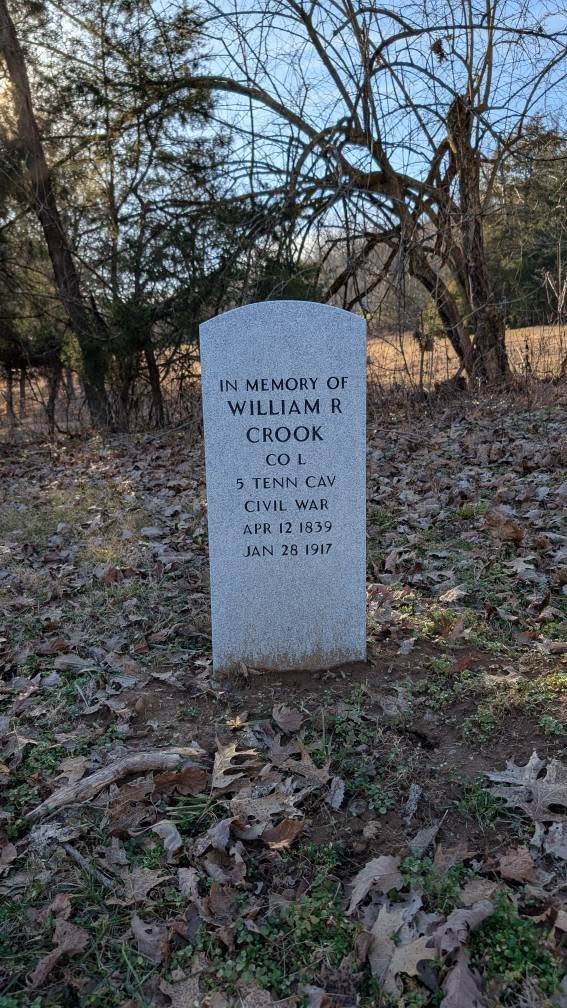
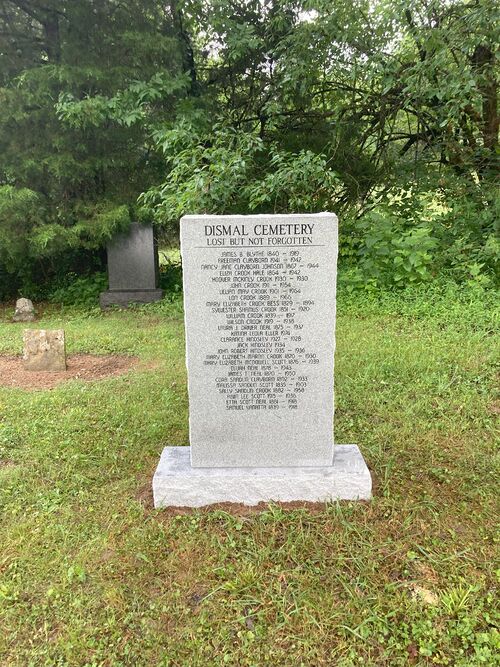
Balancing my life between DeKalb and Vancouver can be a challenge, especially when I’m eagerly anticipating something months in the making. On this trip, it wasn’t the improvements to the house that excited me the most—though setting up the foyer and office was satisfying—but rather the long-awaited placement of the Civil War tombstone for William Robinson Crook in Dismal Cemetery.
Who was William Robinson Crook? He was my great uncle, a cousin to Melissa Etheridge, and a man who left behind a lineage of incredible people I am honored to call family. Though most of his descendants have moved away from the Dismal area, their presence can still be felt—the echoes of children’s laughter by the creek, the memory of little feet running through fields of tall grass. There are countless stories I could share about the more vibrant past of this place, but those will have to wait for another time.
For now, I reflect on the irony of a place named Dismal being so breathtakingly beautiful. It serves as a testament that a community isn’t built with money —it thrives on trust, faith, and, above all, love for one another.
A little about his life…
In the rolling hills of DeKalb County, Tennessee, on a spring day in 1839, William Robinson Crook entered the world. Born to Robinson Crook and Selena Delia Etheridge, William was one of several children in a family rooted in the American South. His siblings included Sarah Frances, Malinda J., Mary Elizabeth, Mathew, Tilmon, Henry Washington, Delilah Elender, and Jeremiah.
As a young man, William married Paralee Driver on March 25, 1858, in DeKalb County. Together, they built a life and raised a family, welcoming children such as John Ervin, Narcissus, Eliza, William Thomas, Nancy, Lucinda Betty, Mary, Cora D., Artelia, and Jenny Bell.
When the Civil War erupted, William answered the call to serve. On August 25, 1863, he enlisted as a private in Company L of the 5th Tennessee Volunteer Cavalry, fighting for the Union. He served until August 13, 1865, experiencing the trials and tribulations of war.
After Paralee’s passing around January 23, 1884, William found companionship again with Lutitia A. Clayborn. They married on June 23, 1899, in Liberty, DeKalb County, and had two sons: George Houston and James H.
William’s life was marked by dedication to his family and country. He passed away on January 28, 1917, in Liberty, DeKalb County, leaving behind a legacy of service and resilience. He was laid to rest in Dismal Cemetery, also known as Fullers Church, in Liberty.
Throughout his life, William navigated the challenges of his time, from the hardships of war to the joys and sorrows of family life. His story is a testament to the enduring spirit of those who lived through one of the most tumultuous periods in American history.
I cannot say enough good things about Bass Funeral Home in Gordonsville. Kurt has been an absolute pleasure to work with on various projects over the past few years. His dedication and effort have been instrumental in making them happen, and I look forward to collaborating with him on future endeavors. Fortunately, his family has deep roots in the area and understands the significance of preserving history. Forgetting our past is akin to erasing it, and I have made it my mission to ensure that those who have been overlooked are remembered. One such individual is William Robinson Crook. It was crucial to me that he be acknowledged once more, as he fought for what he believed in despite having very little.
The Civil War was about far more than just slavery, and as I continue to study the hundreds of books I have acquired in the past year, I hope to gain a deeper understanding of both sides of the conflict. Whether William’s tombstone was lost over time or his family lacked the means to provide one, no one knew where he was buried in the cemetery. I could make educated guesses based on family placements, but accuracy is uncertain, especially considering Martha Roberts Bess is not buried beside her husband, Henry. I would love to trace DNA connections, but legal constraints and moral concerns prevent me from disturbing the graves. Even if I were tempted for that DNA of my great aunts, I’m sure the ancestors would send a sign—perhaps through the local dog, whom I shall call Rex—to remind me to let them rest in peace. Instead, they might guide me towards discovering other ways to find Zilpha’s maiden name, nudging me back to Pendergrass research. My new companion, Hatter, is a great sounding board for my late-night historical investigations, as I continue to explore topics such as how DeKalb County’s shifting boundaries even late into the 1850s affected local families.
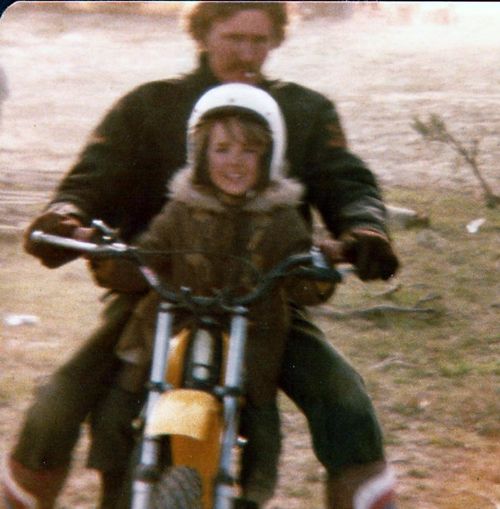
This is only the second tombstone I have placed, but I now realize this is my passion. I understand why I am in DeKalb, and how a childhood memory from Dixon Springs in 1983 shaped me. Arriving in town in a bus with my hippie father, we were initially met with wary glances, as if shotguns were ready to be drawn. But once we connected as kin, we were welcomed into the church, invited onto porches for unsweet tea, and entrusted with church documents and family stories. I still recall staring at an old Coca-Cola machine, puzzled that a soda could cost just ten cents. As much as I struggled with being a gypsy at times, looking back my father did know best, it is the lessons I learned that taught me to move forward in a world with no goal of personal gain, and the universe will give you what you truly need.
In genealogy, we often get caught up in names and dates, but in doing so, we risk losing sight of the individuals behind them. What was daily life like for them? What were their imperfections and strengths? Beyond mapping out the greater DeKalb family tree, I seek to understand their personal struggles and triumphs—through pension files, church records, Supreme Court cases involving murder and road tolls, and local Chancery Court documents detailing estates and disputes. There is no shortage of records to uncover, and each one helps weave the stories of those who shaped our legacy. The key to success in this work is collaboration, ensuring that efforts are not duplicated and that knowledge is shared.
Until I find time to write again—hopefully soon, now that the research rooms are set up—I take pride in our three new First Family certificates. Work is progressing on a military tombstone for Henry Bess, and an even larger project is currently being written up and planned for the coming months. Exciting times lie ahead as we continue to honor the past and bring forgotten histories back into view.
Again Thank you to Kurt at Bass Funeral Home for helping make this a reality –
During my genealogy research journey, I undervalued many records, such as the land deed index books, looking for homestead files that were never earned and Supreme Court Cases files. However, one of my current favourites is the Union Civil War Pension file.
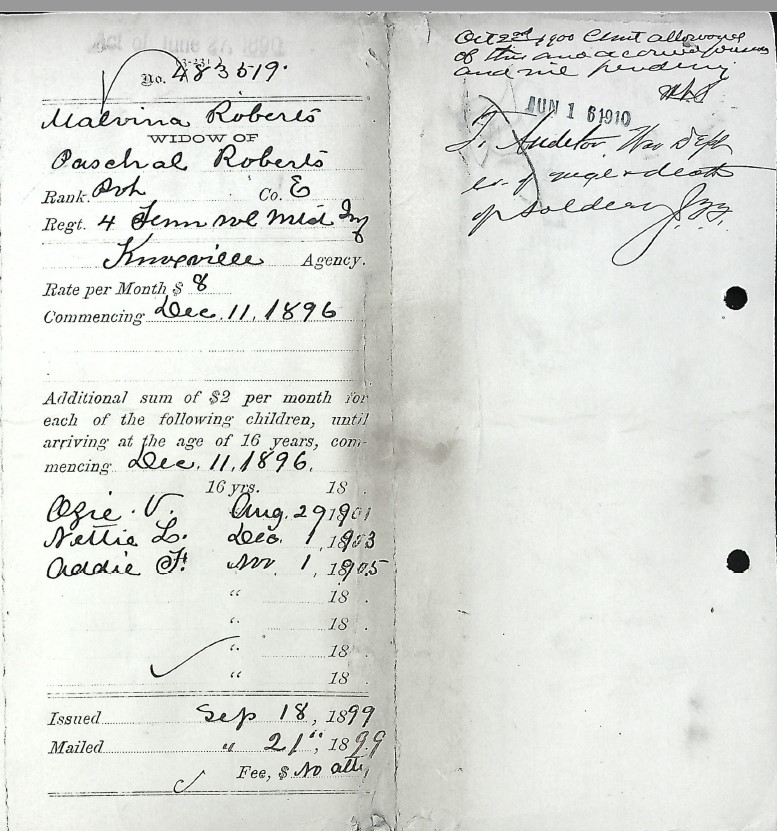
Each file I’ve ordered so far contains between 180 and 300 pages, chock-full of witness statements, marriage licenses, listings of children and wives, and sometimes facts that they temporarily moved to Illinois to avoid conscription.
One of the reasons I didn’t turn to them earlier was the time and cost involved in obtaining them and the frustration of trying to order them through NARA. I had bad experiences where it took them 18 months to tell me they simply didn’t have the file, although I had a pension number for the application and certificate. Then again, the high costs for each one turned out to be private-owned companies that would do the work for you at about 50% of the price and have a monthly turnaround time. I’ve chosen https://gopherrecords.com/ as their flawless track record, with about 20 orders for various documents. (There is no kickback to me for recommending them, other than that I trust them and want you to have the same experience).
With your roots in DeKalb County by 1850, chances are that one of your great grandfathers or great uncles fought in the Civil War. Surprisingly, the Union Soldiers’ count was higher than the Confederate Soldiers. We are lucky that Will Hale left us a list of known soldiers in his work; those names have been transcribed, and as profiles are being added on WikiTree, their profiles are being tagged to the solider they are believed to be, said if they appear to be missing, and noted if a tombstone has been placed for them and if there is a pension file. We are hoping that, eventually, we can order all of the pension files for DeKalb soldiers.
Confederate soldier records are a bit more challenging; some exist and are available at the TSLA, Fold 3, and NARA; unfortunately, in many cases, the records simply did not survive the last 160 years. We are lucky in DeKalb, as William Freddy Curtis has undertaken a historical project focusing on these records. I look forward to speaking with him and hearing more about it. When one person can focus on such an important area, it truly helps us uncover records that may be missed.
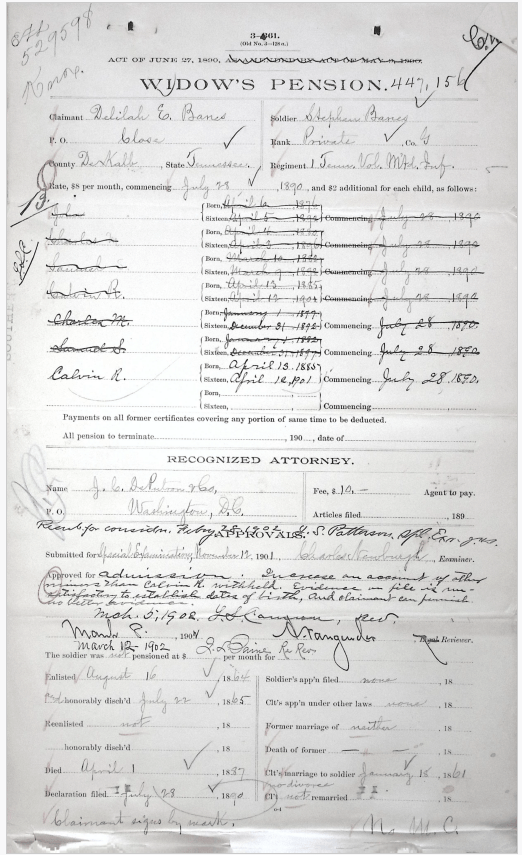
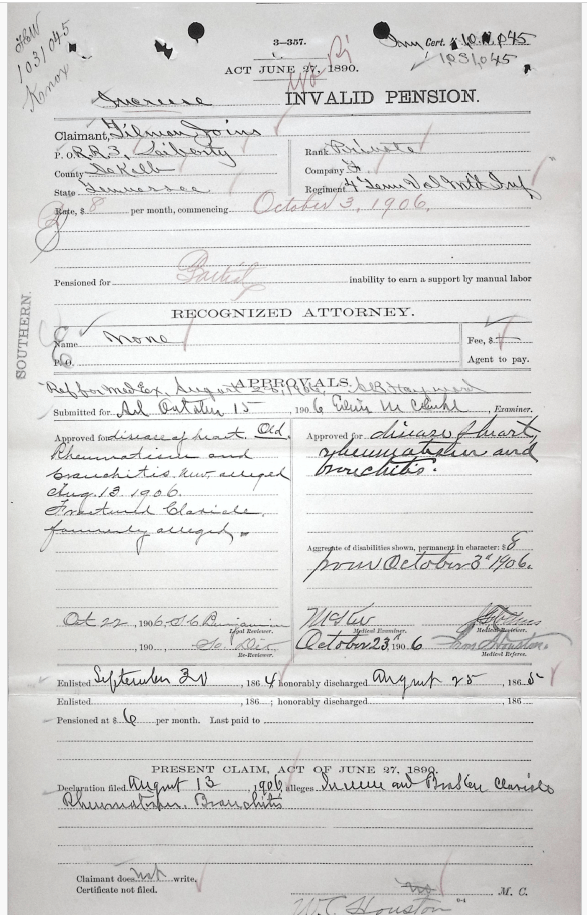
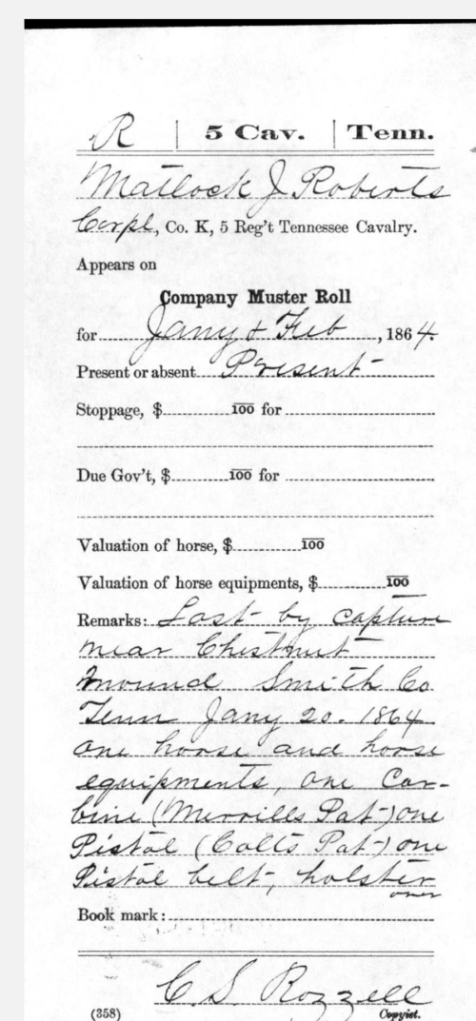
Civil War pension files have helped me clarify a confused identity between Tilmon Joines and Tilmon Jones, both with ties to Dismal. They have also clarified the children and timelines for the family of Stephen Bane and Deliah Crook, and Matlock Robert’s son Paschal was known as Charlie Roberts in his adult days.
However, what has helped the most is adding validation to the parents, siblings, children, and spouses to meet the genealogical standards and avoid errors. While we can think we have the lines correct through census records and marriage records, there is always room for error, where Joines becomes Jones through someone’s transcription, where there are 3 William Crooks’s the same age, and where people don’t know how to spell their own last name, or what their birthdate is. They can help confirm if there was a family bible and, if so, where it was last seen.
In the case of Tilmon Crook, it contains a copy of the divorce decree for him and Dovie Johnson and, for some reason, a lot of Dobson Johnson’s file; I haven’t yet figured out why it’s in there; I’m sure I will sort that out when I read it. They can also provide us clues to mysteries that we do not expect; in the case of William R. Crook’s File, much to my shock, I found the first name of his uncle John Crook’s(1815-1888) first wife is likely Inez(still working on the transcription) as William’s 2nd wife was John’s 4th wife.
As we receive these, they are being added to the WikiTree profiles, and I’m happy to share the original PDF with anyone who can assist. I want to ensure we remove the financial costs from the equation and that they are shared with others, which will help add greater clarity to our collaborative efforts.
We are also working on the first Civil War Tombstone as a part of this. I thank Kurt at Avant Funeral Home for figuring out how to order the honorary tombstone. William R Crook will be the first, as we know he is buried in Dismal; his exact location is unknown, and a mapping project of Dismal will be underway soon to try to identify the most logical place he is at, as his likely won’t be the only new tombstone place there.
As for me right now, I have 4 civil war Pension files to work through; 3 are for the sons of Robinson Crook and the other is Zenith Cripps. Through William R Crook’s file, we know there was a family bible that existed at one time, where it is we don’t, perhaps new clues will be found in the files. Perhaps find our link to the other Robinson line in DeKalb will live amongst it that will help me correct mistakes, and add confidence to other facts. For Zenith, his is the first file I’ve ordered that isn’t related to me, I’m excited to be reaching that stage.
There is another thing the pension files provide us, other then answers and corrections, and that’s richness to the lives of our ancestors. We get to learn about about their neighbors, their health struggles, their journies, their last days, and from what I hear on occasion pictures are found in them, and isn’t that what genealogy is about? While we can have all the facts we want, genealogy would be boring if we stuck with census records, and just the facts.
If you have an ancestor who was in the civil war, see if you can find a pension file for them, their widow, their children, their siblings, and take the jump to order it, you won’t regreat. Please also keep in mind if funds are an issue, let me know and we will see about ordering it for you, as our ancestors should not be hidden behind a pay wall, as no one owns them.
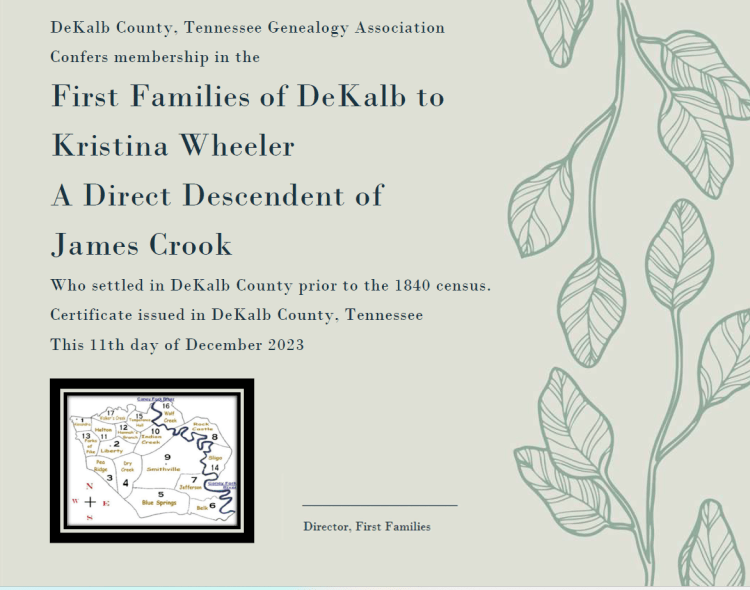
We are excited to announce that the first families program is entirely up and running, with the first certificates received by the applicants last week.
As this is a new program, we will continue to make changes to the application and clarify questions, and we hope to have a document for Frequently Asked Questions up sometime soon.
If you are interested in completing and submitting an application, they can be found here: Link to Application Page.
And other updates
Civil War Pension Files
Over the last few months, we have added the pension files of Stephen Bain and Tilman Joines to the collection. If you have a pension file for a DeKalb Ancestor, we would love it if you could share it so we can add it to the digital files and make it easier for others to collaborate and ensure everyone has all the information. If you require a file for an ancestor and budget is a constraint, please remember that we have the Matlock & Zilpha Roberts Grant program to help obtain the pension files for our DeKalb Ancestors.
WikiTree Project
The WikiTree project continues to go, sometimes a bit slower, but we are now nearing 5,000 individuals tagged to DeKalb. With each connection, we better understand how everyone is related and can possibly identify ways to break through the brick wall when working with clues.
If you have documents, such as church records, family bibles, and diaries from our ancestors, that you would like shared so others can find them, we are happy to help. Sometimes, it may take longer to get online, depending on the time available to work on special projects.
Work on the diaries of Rev. Wauford and David Taylor will soon be resumed to match the details in their diaries to the individuals they refer to.
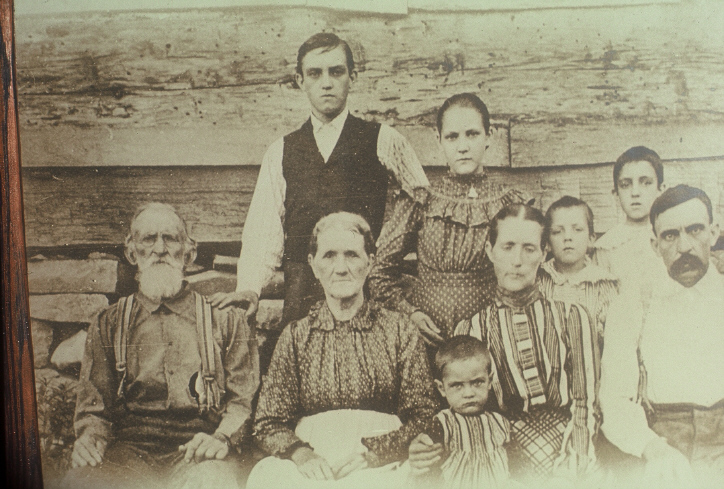
We’d also like to thank Jerry Parker for allowing us to share his amazing photo in his collection; it will be added to Wikitree with the right profiles shortly. If you have photos you’d like to share, we’d love to see them and add them.
1904 photo of the Joseph Parker family: seated L to R are B. F. “Dock” Murphy, Eliza Dennis Parker, Marvin Parker, Sarah Murphy Parker, Joseph Napoleon Parker; standing L to R: Robert Sherman Parker, Eliza Parker, Frank Parker, and Fred Parker. – Permission to post by Jerry Parker
Volunteering
If you are interested in helping to verify applications and documents, have a Gmail account, and are familiar with Gmail, please let me know. It will still be a few months before I can be there in person to host a meeting, hoping that April may be possible. I am starting to shop for homes in and around DeKalb, but it will still be a few months before things are complete. However, we could look at hosting a virtual meeting through Zoom, or if someone wanted to host one there, we could set up a laptop with a camera so that those unable to attend in person can be there virtually.
We still hope to create a logo. If you have the skill to do this, we would love to see your design thoughts! We also welcome any special talents you have. Share those and your passions with us, and we can find a match for you.
There are also many projects we’d like to see come to light, such as transcription of highlights of Supreme Court Cases that involved DeKalb and building out profiles for Civil War Veterans and those here in 1840.
I have not heard back from city hall about collaborating on the First Families program, so I have now contacted the Chamber of Commerce. I hope to hear back from them, as it would provide an excellent opportunity for collaboration.
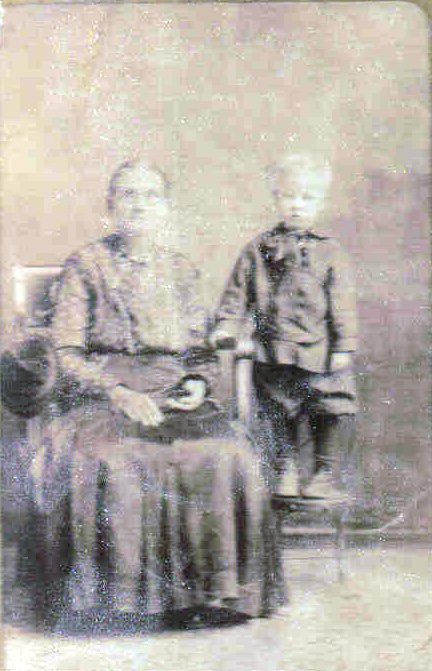
Malvina Wauford Roberts(1853-1928), with her grandson Elmer, is believed to have been taken in Fannin County, Texas.
The diary, purchased in 1904, contains the names and dates of births, deaths, and tragic events in and around DeKalb County that he was aware of. It also appears that he transcribed notes from earlier diaries into the new one, including family events in the time frame from 1851 into the last 1930s.
Work has been done in formatting and validating some of the events listed to newspaper events that provide more significant details. In comparing the dates he has recorded, you may notice some variances in FindAGrave death dates; however, where death certificates have been reached, his date has been seen to match the death certificate date, and the tombstone is incorrect.
In reviewing the diary, you’ll find many names linked to the profiles of the individual; some have notes from Darrell Spencer, with additional notes noted as (KW-) and other notes specific to the event.
Diaries are invaluable as they give us a condensed version of life in a small town over a defined period. Some, such as Rev Waufords, help us see what each day during the year brought and the insight into someone’s inner thoughts to get to see them; others, such as Rev. Taylor, allow us to see the bigger picture of life in a community over the decades.
WikiTree is a collaborative genealogical platform which allows multiple people to work on the same project. When working on the page, we save the update after each new person is linked; this helps reduce the potential overwriting of the work of others.
If you are interested in working on the diary and connecting the names mentioned by Rev. Taylor to profiles and are familiar with WikiTree, please feel free to start anytime. If you aren’t familiar with WikiTree and would like to participate, even if not on WikiTree, simply identify the individuals on Find A Grave or Family Search; this will help make work quicker to link them to WikiTree profiles. Please let us know at dekalb.tennessee.genealogy@gmail.com.
Several DeKalb county ongoing projects include Our First Families, War Veterans from 1812 to current times, and Diaries. DeKalb has a profound history that deserves to be shared.
If you have family diaries, photos, oral or written histories, or other items essential to the history of DeKalb, please let us know; we’d love to work with you and start a project for them.
Photo of Holmes Creek School found by Daphene Willoughby – Nashville Tennessean on 29 January 1928 page 2
Photo of Rev. David Taylor provided by Darrell Spencer
People often underestimate the types of records available in their genealogy work. I’ve always believed you can find what you seek if you search hard enough.
One of our goals as genealogists is to learn about who are ancestors were, quite often we must accept only the facts and figures of their census records, perhaps a deed that happened, however once in a while, we get to truly get to know our cousins in a way that speaks to who they were.
Lucking out by finding newspaper articles and, once in a while, a true treasure that is beyond precious, a diary. Diaries can contain valuable information about births, weddings, and deaths in a community, where other evidence can fail to be found.
Charles was born in Helton, DeKalb County, the son of Samuel David Warford and Rachel Ann McCullogh. He would serve as a military chaplain in World War I and become a Baptist minister.
Luckily Daphene, knowing that the diaries of Charles were important, took the opportunity to transcribe many of these when she had them. The original copies are in the Carthage Library in Smith County, Tennessee.
An additional diary covers his ordination and encompasses the 1903-1909 years. This awaits transcription, and work will be done to digitize it to share later this year. A hidden gem in this diary is that it also shares a complete list of all the sermons he preached until 1929.
We are lucky to have the 1909, 1910, 1911, 1912, 1913, 1915, 1921, 1922, and 1924 diaries. Charles was dedicated to making his entries each day, and we journey through his life one day at a time through his thoughts on the weather, how close he was to his family, and his life with his wife Helen Fay Grigsby Wauford(1892-1940).
We are excited to share these today and look forward to adding additional ones. These links will take you to the WikiTree pages for the diaries and see them as transcribed.
We hope you enjoy reading these as much as we have, and we look forward to rereading them as we integrate the information in his profile and those of the lives he touched.
For myself, this was an extraordinary journey to travel back 100+ years, getting to know a cousin in such an intimate way and imagining the warmth of my DeKalb family, who understood and found contentment in peace and simple life.
Please grab a cup of tea and join me on an intimate journey to get to know life at a slower time.
If you have diaries for those who lived in DeKalb, we’d love to see them and share them with our DeKalb family; we can be reached at dekalb.tennessee.genealogy@gmail.com.
DeKalb has had many outstanding researchers, including Jorene Parsley, Will T. Hale, and Tommy Web. They have left an incredible collection of research material that was painstakingly created through thousands of hours of dedicated work. I have also had the pleasure of interacting with many local researchers who have also spent thousands of hours walking through cemeteries to take photos, creating the FindAGrave Memorials, and linking families.
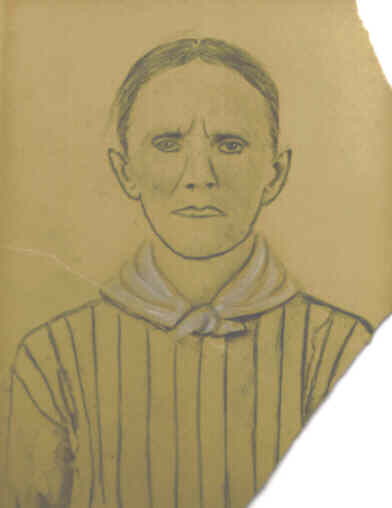
My journey to Dekalb started when I was only a teen, leaving behind a hand-drawn image of Zilpha Roberts, who moved to DeKalb between 1860-1870 into the Dismal area, buying land from the Drivers. I long wondered exactly how to start my genealogy journey when I finally had the opportunity to use this weird thing called the internet back in 1993.
Many hours were spent trying to email people that might have the most minor clue, self-addressed stamped envelopes with requests for record look-ups, then the very, very precious first indexes of DeKalb County, followed by Chancery and Land Deed Books with snippets.
A love affair was born between me and my roots, and although I do work on other lines, the ones through DeKalb have always been a priority. Maybe because I was given that photo, I bonded with my roots there to the point I’ve now put an offer in on a home with plans to live there about 20% of the year.
Zilpha and her husband Matlock have many descendants still in DeKalb. However, very few know of them. I’d hoped desperately there would be some magic file in the vertical files and knew there had to be, with a family Bible image that gave us their parents’ names. How could they be the forefathers of so many in the county, yet no one knew their roots?
In 2021, I finally got to visit for a month and indulge in every research whim I’d had for a few decades. I returned from that trip with a greater attachment to DeKalb and thousands of images of books, tombstones, vertical files, and other assorted items if needed later.
In 2022 I came for a visit again, a little less research time, as dogs are really allowed in libraries. I spent more time finding peace in the area through hiking, driving and knew I needed to be there. During the last few years, I’ve also gotten to know many local researchers and started a one-place study on DeKalb, specifically Liberty, Dismal, Dowelltown, and Alexandria. During this time, I changed from a researcher of my line to a community-based form of genealogy, understanding the power of sharing and collaboration.
A few weeks back, someone approached the Facebook group asking if there was a First Families program, and there was neither one nor a genealogy association in Dekalb. I realized we need a first families program, as there are so many incredible stories, so sure, let’s create one. But then, well, it’s a little weird if an individual is going it, so I talked to a few other researchers and The DeKalb Genealogy Association was born!
We are at the infant steps, first identifying what the goals need to be done, as we do not need to recreate the projects on the Dekalb Gen Web or the WikiTree projects. But it can house the information for First Families, Cemetery Projects, Military Grants, Veterans, and other projects.
So if you have an idea or a unique talent, please consider joining and helping. It truly takes all of our kin collaborating to make the most of the DeKalb History, and we all look forward to working together!
Through collaboration, we can obtain those long sought-after records to help clear up mysteries in our lines and memorialize those who have passed away so they are not lost to the annals of time while memorials sink and become damaged.
In the immortal words of Alice – If we don’t know where we are going, does it really matter which road we take? Looking forward to this adventure with all of my cousins by my side.







 DeKalb County, Tennessee Genealogy Association