Balancing my life between DeKalb and Vancouver can be a challenge, especially when I’m eagerly anticipating something months in the making. On this trip, it wasn’t the improvements to the house that excited me the most—though setting up the foyer and office was satisfying—but rather the long-awaited placement of the Civil War tombstone for William Robinson Crook in Dismal Cemetery.
Who was William Robinson Crook? He was my great uncle, a cousin to Melissa Etheridge, and a man who left behind a lineage of incredible people I am honored to call family. Though most of his descendants have moved away from the Dismal area, their presence can still be felt—the echoes of children’s laughter by the creek, the memory of little feet running through fields of tall grass. There are countless stories I could share about the more vibrant past of this place, but those will have to wait for another time.
For now, I reflect on the irony of a place named Dismal being so breathtakingly beautiful. It serves as a testament that a community isn’t built with money —it thrives on trust, faith, and, above all, love for one another.
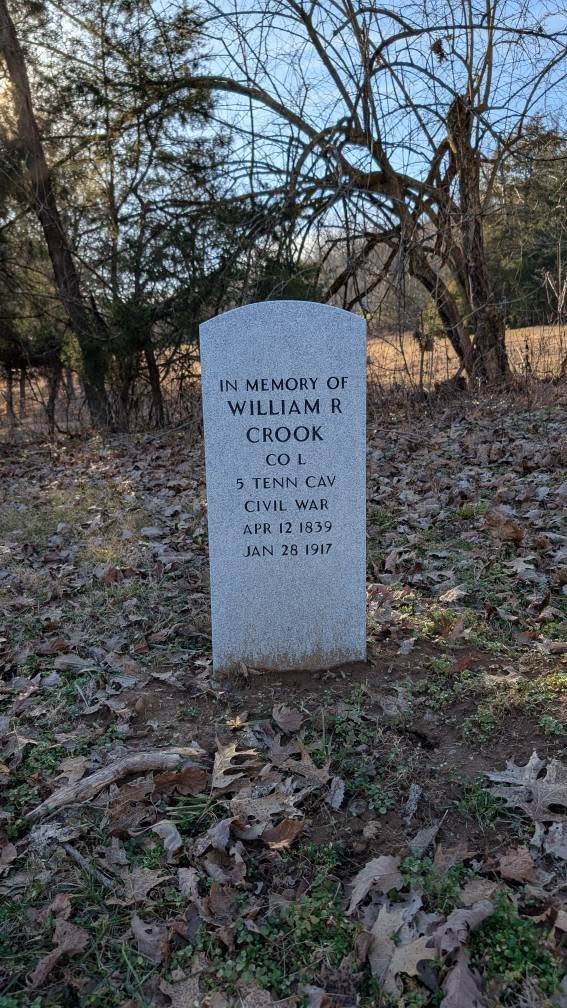
A little about his life…
In the rolling hills of DeKalb County, Tennessee, on a spring day in 1839, William Robinson Crook entered the world. Born to Robinson Crook and Selena Delia Etheridge, William was one of several children in a family rooted in the American South. His siblings included Sarah Frances, Malinda J., Mary Elizabeth, Mathew, Tilmon, Henry Washington, Delilah Elender, and Jeremiah.
As a young man, William married Paralee Driver on March 25, 1858, in DeKalb County. Together, they built a life and raised a family, welcoming children such as John Ervin, Narcissus, Eliza, William Thomas, Nancy, Lucinda Betty, Mary, Cora D., Artelia, and Jenny Bell.
When the Civil War erupted, William answered the call to serve. On August 25, 1863, he enlisted as a private in Company L of the 5th Tennessee Volunteer Cavalry, fighting for the Union. He served until August 13, 1865, experiencing the trials and tribulations of war.
After Paralee’s passing around January 23, 1884, William found companionship again with Lutitia A. Clayborn. They married on June 23, 1899, in Liberty, DeKalb County, and had two sons: George Houston and James H.
William’s life was marked by dedication to his family and country. He passed away on January 28, 1917, in Liberty, DeKalb County, leaving behind a legacy of service and resilience. He was laid to rest in Dismal Cemetery, also known as Fullers Church, in Liberty.
Throughout his life, William navigated the challenges of his time, from the hardships of war to the joys and sorrows of family life. His story is a testament to the enduring spirit of those who lived through one of the most tumultuous periods in American history.
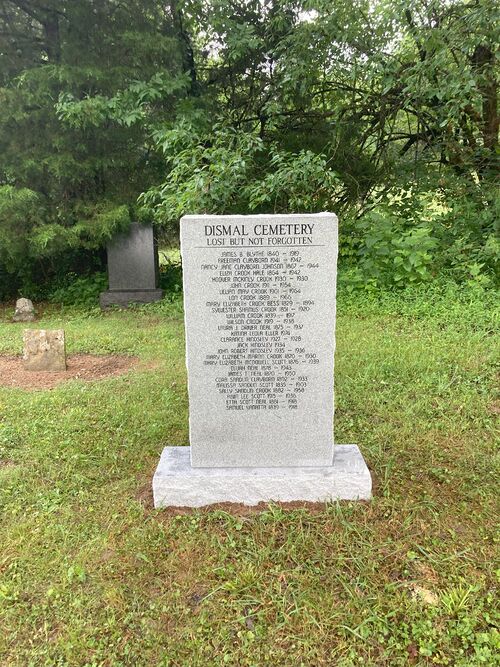
I cannot say enough good things about Bass Funeral Home in Gordonsville. Kurt has been an absolute pleasure to work with on various projects over the past few years. His dedication and effort have been instrumental in making them happen, and I look forward to collaborating with him on future endeavors. Fortunately, his family has deep roots in the area and understands the significance of preserving history. Forgetting our past is akin to erasing it, and I have made it my mission to ensure that those who have been overlooked are remembered. One such individual is William Robinson Crook. It was crucial to me that he be acknowledged once more, as he fought for what he believed in despite having very little.
The Civil War was about far more than just slavery, and as I continue to study the hundreds of books I have acquired in the past year, I hope to gain a deeper understanding of both sides of the conflict. Whether William’s tombstone was lost over time or his family lacked the means to provide one, no one knew where he was buried in the cemetery. I could make educated guesses based on family placements, but accuracy is uncertain, especially considering Martha Roberts Bess is not buried beside her husband, Henry. I would love to trace DNA connections, but legal constraints and moral concerns prevent me from disturbing the graves. Even if I were tempted for that DNA of my great aunts, I’m sure the ancestors would send a sign—perhaps through the local dog, whom I shall call Rex—to remind me to let them rest in peace. Instead, they might guide me towards discovering other ways to find Zilpha’s maiden name, nudging me back to Pendergrass research. My new companion, Hatter, is a great sounding board for my late-night historical investigations, as I continue to explore topics such as how DeKalb County’s shifting boundaries even late into the 1850s affected local families.
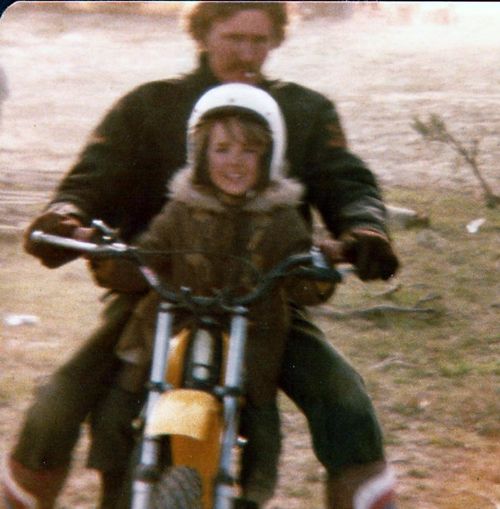
This is only the second tombstone I have placed, but I now realize this is my passion. I understand why I am in DeKalb, and how a childhood memory from Dixon Springs in 1983 shaped me. Arriving in town in a bus with my hippie father, we were initially met with wary glances, as if shotguns were ready to be drawn. But once we connected as kin, we were welcomed into the church, invited onto porches for unsweet tea, and entrusted with church documents and family stories. I still recall staring at an old Coca-Cola machine, puzzled that a soda could cost just ten cents. As much as I struggled with being a gypsy at times, looking back my father did know best, it is the lessons I learned that taught me to move forward in a world with no goal of personal gain, and the universe will give you what you truly need.
In genealogy, we often get caught up in names and dates, but in doing so, we risk losing sight of the individuals behind them. What was daily life like for them? What were their imperfections and strengths? Beyond mapping out the greater DeKalb family tree, I seek to understand their personal struggles and triumphs—through pension files, church records, Supreme Court cases involving murder and road tolls, and local Chancery Court documents detailing estates and disputes. There is no shortage of records to uncover, and each one helps weave the stories of those who shaped our legacy. The key to success in this work is collaboration, ensuring that efforts are not duplicated and that knowledge is shared.
Until I find time to write again—hopefully soon, now that the research rooms are set up—I take pride in our three new First Family certificates. Work is progressing on a military tombstone for Henry Bess, and an even larger project is currently being written up and planned for the coming months. Exciting times lie ahead as we continue to honor the past and bring forgotten histories back into view.
Again Thank you to Kurt at Bass Funeral Home for helping make this a reality –

 DeKalb County, Tennessee Genealogy Association